
This is the third in a three-part series I am sharing with my readers about teaching children about their brains. I have invited my readers to consider how even young children can learn brain basics, which can be very empowering, helping them understand and manage their thoughts and feelings, including some often-challenging ones, like fear and anxiety.
In my first blog I shared that children of different ages and levels of maturity can understand some basics but not others; it is up to adults to decide what a child is capable of understanding. I suggested that parents and caregivers begin with basic brain information to explain how the brain functions. I shared information about neurons and how they must connect with each other to function. I also described the six most significant brain parts.
In my second blog I invited parents and caregivers to learn ways to teach children about Bruce Perry’s model of brain states and how each of us is in a particular brain state in any given moment. Children can learn that brain states impact their thoughts and feelings and how time is experienced.
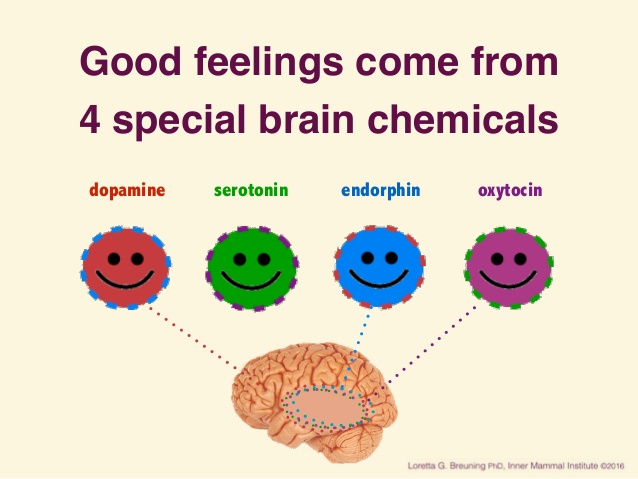
In this final blog describing ways adults can teach children about their brains, I encourage parents and caregivers to explain how the brain is a kind of chemical factory and the chemicals it releases impact emotions. It is these chemicals that are at the heart of feelings like joy and excitement, fear and anxiety, and all the other many feelings any of us, including children, can experience.
Not all children understand the concept of chemicals and a chemical reaction. Adults can share that there are chemical reactions all around us. For example, when an egg is cooked, the combination of the heat and the egg change the egg. When you eat food, your body knows how to send some chemicals into your stomach that allow it to digest the food. Some children may be familiar with ways they can make a model volcano by mixing baking soda and vinegar to cause an “eruption” which is a chemical reaction.
Another illustration children might appreciate: Imagine for a minute that every day of your life you stood in a shower that provided a continuous stream of water. Most of the time the water came in the same slow and steady way. Sometimes it was a little stronger and other times the pressure would go down, but the shower was relatively consistent. Perhaps, once in a while, someone would run water somewhere else in the house and the shower might get suddenly much cooler or much warmer but would return quickly to its normal state.
Now imagine that you were in a shower that went on and on. At times the force of the water would be so strong it would hurt your skin and even bruise it. As much as you might twist and turn, the pain would continue. Imagine if the water gets so hot sometimes you could hardly stand it and at other times it might be so cold that it made you feel as if you were freezing.
Much like this continuous shower image, the human brain is in a constant state of being bathed by its own chemicals. In a normal, non-hyper-stressed brain, the shower is fairly consistent and the pressure remains within a tolerable range. In a brain that has experienced or continues to experience toxic stress, bathing can be a very unpleasant and harmful experience, much like the second shower image.
Another interesting fact: Dr. Louis Cozolino in his book The Neuroscience of Human Relationships (p. 402), shares that the amygdala, which stores memories and tells the brain to release neurochemicals of fear and anxiety, is larger in children who suffer from chronic anxiety.
One more interesting fact from Dr. Cozolino (p.40): feelings of love activate endorphins and dopamine, the neurochemicals of happiness and joy.
I am hopeful that the information contained in these three blogs can help parents and caregivers teach children about their brains and can encourage them to do the kinds of things that promote health in their relationships and in their abilities to understand and even control some aspects of their brains. Once family members become aware and understand how the brain functions, parents and caregivers can invite children to use what they now know to continue nurturing their own brain health, appreciate which brain state they or others might be in, recognize how their brain’s neurochemical system is impacting their emotions and become more in charge overall of how their brain is functioning. They also can now understand why others are behaving as they are and what might be helpful for them to understand so they too can be more in charge of their brains. Pretty cool, huh?
Invitation for Reflection
- Think about the information and suggestions in these three blogs.
- What stands out for you? What has contributed to your own knowledge base? What have you tried to share with the children in your life?
- How have they responded?
- If you have shared some of this with a child in your life, what did you notice in their response to it?
- Did they seem to understand it? Could they apply it to themselves?
- Did they feel empowered?
- Are you inspired to do some of your own research to add to what you now know and what might help increase your children’s understanding of their brains?
Some additional resources:
- The Brain Builders – All About Neurochemicals – Momma Bear Audio
- Brain Basics: Anxiety for Kids – with Lee Constable
- happy-brain-chemicals-dopamine-serotonin-oxytocin-and-endorphin-2-638.jpg (638×479) – Source of following chart

Diane Wagenhals
Director Emeritus, Lakeside Global Institute